Circled takes, explained: what they mean and who circles them
A circled take is a take marked as preferred or worth drawing editorial attention to. Here is where the term comes from and what it means on a modern shoot.
If you spend enough time around film sets, somebody will eventually say: "Circle that."
The phrase is old, but the idea is still useful.
A circled take is a take that has been marked as a preferred option, traditionally following a decision from the director and recorded in the production paperwork by the appropriate crew member, often the script supervisor.
It does not mean every other take is useless. It means: start here.
Why are takes circled?
The term comes from film-era production workflows. Takes were recorded on paper reports, and selected takes could be visibly marked, often by circling the take number. The language around "printing" also comes from the photochemical process, when selected negative would be printed for viewing and editorial work.
Exact reporting practices varied between productions and departments, but both "circle" and "print" survived the move to digital because the underlying editorial problem remained. A shoot can generate a lot of material. Somebody who was present needs a quick way to indicate which takes were considered strongest.
Who decides which take gets circled?
Normally, the creative judgement comes from the director. On a production with a script supervisor, that preference can be recorded as part of their notes and editorial documentation. Other departments may maintain their own reports and metadata as well.
On smaller commercials, branded films and music videos there may be no script supervisor at all. In that situation, the important thing is not reproducing a full studio paperwork system. It is preserving the decision somewhere reliable. If the director says take four was the one, mark take four while everybody still remembers why.
Does the editor only use circled takes?
No. A circled take is a steer, not an instruction to ignore everything else.
An editor may start with preferred material because it gives them useful information about the director's judgement on set. They may then use entirely different takes because of performance, continuity, timing, focus, sound or simply because another version cuts better. That is normal.
A circle makes the search more informed. It does not make the editorial decision.
Can you circle more than one take?
On paper, yes. There may be two performances the director likes for different reasons. One might be safer, one might be funnier. One might have the strongest acting but a technical issue.
There is no rule in the trade saying a setup needs one single winner. Storybrdr holds to one anyway: circling a second take moves the circle rather than adding one, because "the take we used" is a single answer for the edit to start from. Everything else you want to say about a take goes in the note for the editor.
What does "print it" mean on a digital shoot?
Usually some version of: that was good, mark it.
Nobody needs to physically print the take for the language to survive. Film sets are full of terminology whose original technology has disappeared.
How does Storybrdr handle it?
In Storybrdr's On Set view, takes are logged against the shot while you shoot, and a take can be circled the moment the director calls it rather than written down somewhere else and reconstructed later.
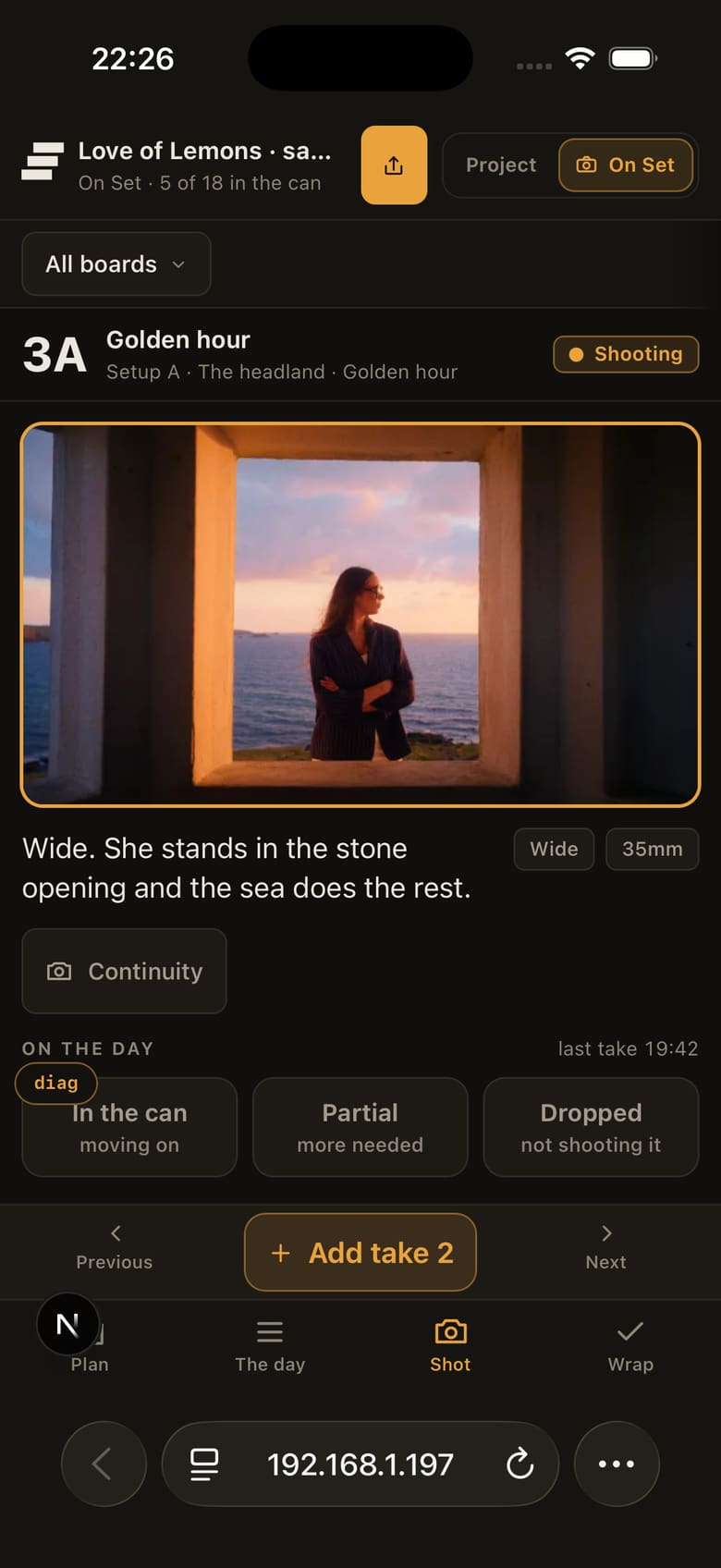
The modern circle: a hold on the take, recorded the moment the director calls it.
The point is not to reinvent script supervision. It is to preserve one of its most useful habits on productions where nobody is sitting beside the monitor dedicated to maintaining a full script supervisor's record. What the editor needs from your shoot covers the rest of that record.