What the editor needs from your shoot
What information travels from set into post-production, how professional script supervision handles it, and what smaller crews should make sure they preserve.
An editor receives more than footage. Or at least, on a well-run production, they should.
The useful information from a shoot includes what was filmed, which takes were preferred, what coverage exists, what went wrong, what changed and anything that will help editorial understand material they were not there to witness.
On larger scripted productions, a lot of that knowledge travels through established script supervision and departmental reporting. On a small commercial, music video or branded film, there may be no dedicated script supervisor at all.
The paperwork can change. The editor's questions do not.
On larger productions
Exact documentation varies by production, but a script supervisor's work can include several important records.
The lined script. A lined script visually records how the script was covered. Lines through the script indicate which portions of a scene were covered by different setups. For editorial, it becomes a quick way of understanding what visual coverage exists around each part of the scene.
Facing pages and script notes. Detailed notes may record setups, takes, performance or continuity observations, timings and other information from the day. These records preserve context that is not necessarily obvious from watching a clip in isolation.
Preferred or circled takes. The director's preferred material can be recorded so editorial has an immediate steer towards takes that were considered successful on set. It is guidance, not a restriction. Circled takes, explained covers the term properly.
Continuity information. Continuity notes and photographs preserve the details that need to match across angles, scenes, days and potential pickups.
Camera and sound reports. Camera and sound departments maintain their own records connecting rolls, files, cards, takes and technical information.
Depending on the size and type of production, assistant editors may use several of these sources when preparing the material.
What changes on a small shoot?
Often, almost all of it. A four-person branded-content crew is unlikely to produce the same documentation as a drama unit. That does not mean the information is suddenly irrelevant. It just means somebody needs a simpler way of preserving it.
On most small shoots, four habits carry most of the value.
Mark the useful takes. Do it while shooting. Do not assume you will remember on Tuesday why everybody loved take six on Friday.
Note what the footage will not tell the editor. Technical problems. Alternative performances. Client requests. Pickup reasons. Moments where the director deliberately changed the plan. A single useful sentence can save a lot of guessing in post.
Photograph things that may need to match. If wardrobe, set dressing, product, hair or props may need to be recreated later, take the photograph now.
Keep the record together. The weakest handover is normally not missing information. It is information spread between five places. A notebook, the producer's phone, the director's camera roll, a spreadsheet, a text message sent at 11:30pm. The editor needs the knowledge, not an archaeological dig.
Where Storybrdr fits
The short version is that the board itself goes to the shoot day, so what the editor receives is a record of what actually happened rather than a document somebody retyped afterwards.
Storybrdr is not trying to replace professional script supervision on a large scripted production. That would be the wrong claim.
What we wanted was a useful version of the same discipline for productions where the crew is smaller and nobody owns that entire job. Takes can be logged against the storyboard shot. The take the director wants is circled while you are still on it. Notes remain with the material they refer to. Continuity images attach to the shot rather than disappearing into a general camera roll. At the end of the day, the record can be handed to editorial without rebuilding it from memory.
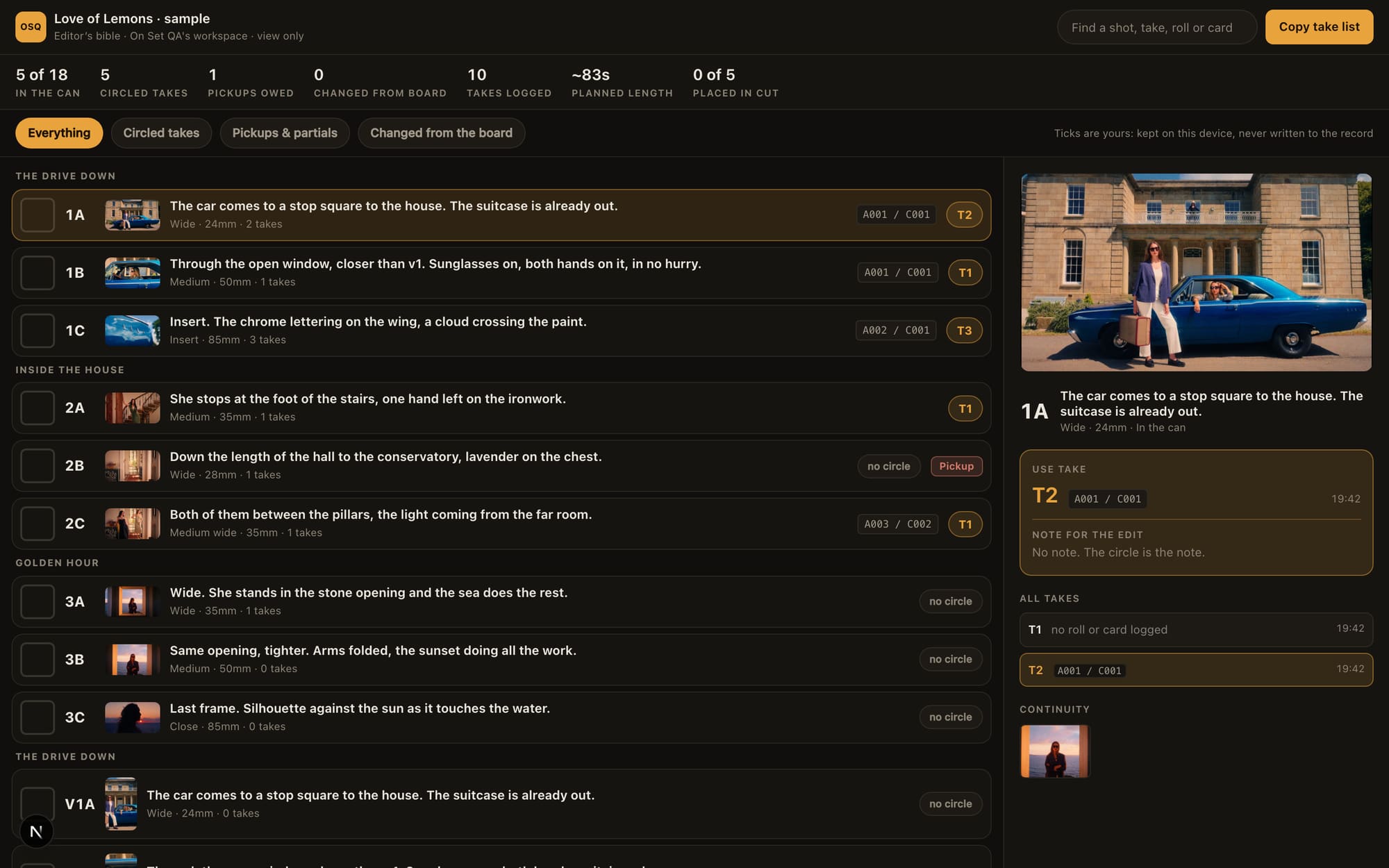
The handover as the editor receives it: one link, the whole day.
That is a relatively small idea. But if you have ever started an edit with a drive full of clips named C0037 and the message "pretty sure the last takes were best", it solves a very real problem.