How to storyboard a commercial
A practical process for turning a script or idea into a board that works for the director, the client and the crew who eventually have to shoot it.
A commercial storyboard has to work for several different people at once. The director needs to see the film. The client needs to understand it. The producer needs to know it can actually be made. The crew needs enough information to turn those frames into a shooting day.
That is why I do not think of a storyboard as a collection of nice images. It is the point where the creative starts becoming a production.
Here is how I approach it.
Start with what the film has to communicate
Before thinking about lenses or coverage, identify the moments the idea depends on. That might be a performance beat, a reveal, a product moment, a change of pace, a line that only works if we see the reaction.
Those are your anchors. If the film still makes sense when you look at nothing but those frames, the underlying structure is probably doing its job. Only then start joining them together.
Think about shot economy, not shot count
There is no useful rule saying a 30-second commercial should contain a particular number of shots. A performance-led film might stay with a handful of setups. A fashion or product montage might cut dozens of times.
The better question is whether each shot earns its place. I want to know what a frame is doing. Is it establishing geography? Giving me a performance moment? Creating a transition? Showing product? Changing energy? Giving the edit an option it genuinely needs?
If three shots are doing exactly the same job, I probably have not made the decision yet.
And every additional setup has a production cost. It takes time to move camera, relight, reset art department, change wardrobe or turn the room around. The board needs to respect that.
Build a visual language, not a Pinterest folder
References are incredibly useful in commercial storyboarding, but they need to feel like the same film. A beautiful image that belongs to a completely different visual world can make the board worse rather than better.
I am looking for consistency in things like composition, camera height, movement, lens feeling, colour, lighting, performance and production design.
Clients read a board much more instinctively than filmmakers sometimes realise. If five consecutive frames feel like five different commercials, they will feel that before they can explain why.
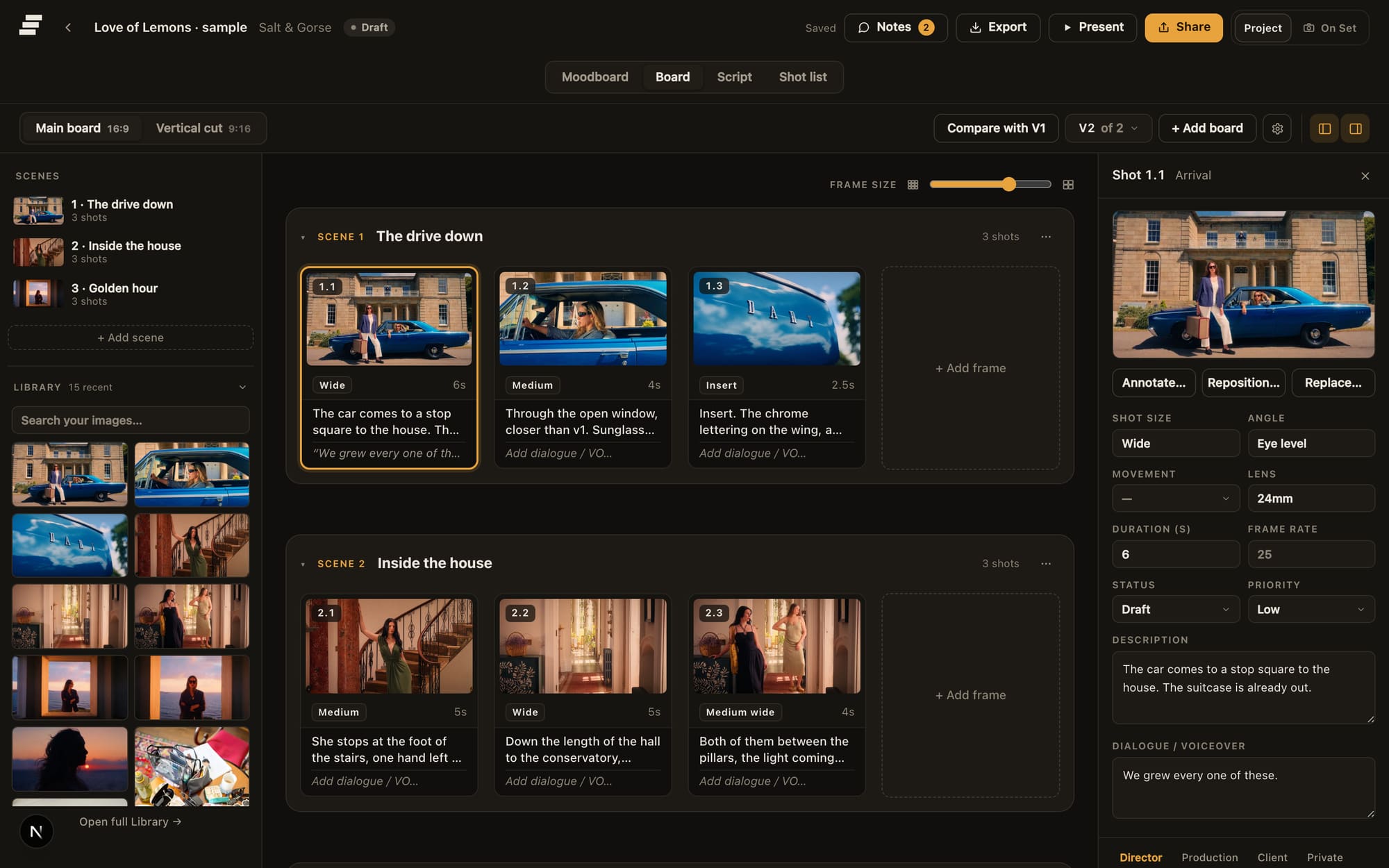
One visual language across the board: the sample project's frames belong to the same film.
Decide when you need drawn frames
Photographic references are brilliant for communicating tone, locations, casting, texture and light. But they are not always enough.
If the frame depends on a specific piece of blocking, a camera move, a gag or a composition that does not exist in reference imagery, draw it or commission a storyboard artist. There is no prize for using one type of frame throughout. Use whatever communicates the intention most clearly.
Put the words where the picture happens
Dialogue, voiceover and key sound information should sit with the relevant frames. A client should be able to move through the board and understand the relationship between what they are hearing and what they are seeing.
This becomes especially important when timing is tight. A visually beautiful board that hides the actual structure of the script is not doing its job.
Decide what travels with each frame
A picture on its own is a mood. What makes a board usable by a producer is the handful of facts underneath it, and the useful discipline is deciding which ones you actually know yet.
On a commercial I want, per frame: what the shot is, what happens in it, roughly how long it runs, and any dialogue or voiceover landing over it. Lens, movement and camera angle go in when they are a decision rather than a guess. Writing "85mm" against a frame nobody has recced yet just gives the crew something to hold you to.
That is also the moment the board stops being a deck and starts being the first draft of the shot list. If the durations are honest, the producer can add them up. If the setups are legible, the first AD can group them. A blank shot list template is a quick way to see whether your board carries enough to fill one.
Board the formats you actually have to deliver
Commercials rarely live in one aspect ratio any more. If the production needs 16:9, 9:16 and 1:1, think about that before the shoot.
You do not necessarily need a completely separate storyboard for every format, but you do need to know which compositions survive and which do not. A frame that only works because the subject is sitting on the extreme edge of 16:9 is going to tell you something useful about the vertical version.
Finding that out in prep is cheap. Finding it out with 25 people on set is not.
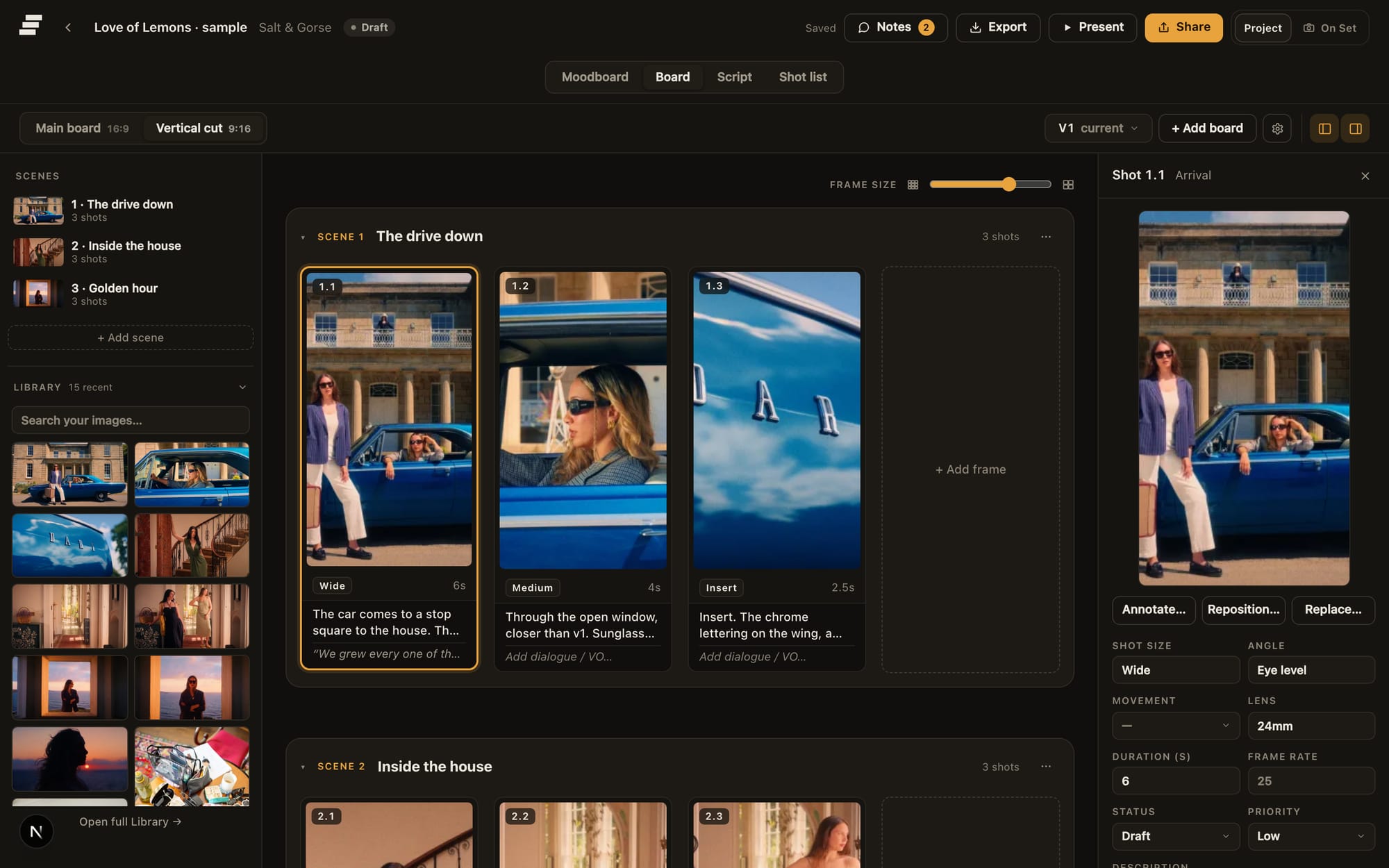
The same job's 9:16 duplicate: the compositions that survive, reframed on purpose.
Getting it in front of the client
The board goes out in a fairly predictable run, and most of the pain comes from skipping a step rather than doing one badly.
- Send one version, not a folder. One link or one PDF, named so nobody has to guess which is current. Multiple attachments in one email is how you get notes on the wrong cut.
- Say what you want back, and by when. "Notes by Thursday lunchtime so we can turn it before the recce" gets a faster answer than "let me know your thoughts".
- Make notes land on the frame. A comment on frame 4 is worth ten lines of an email describing frame 4. If the tool cannot do that, number the frames and ask people to quote the number.
- Answer every note, including the ones you are not taking. Silence reads as disagreement. "Kept the wide here, because the reveal stops working if we cut in" ends a conversation that would otherwise come back on the day.
- Reissue as a new version rather than editing the old one. Then "the board the client approved" is a thing that exists, not a memory.
- Get the approval in writing, against that version. A name and a date, on the version they actually looked at.
Agency work usually has a round inside the round: the agency producer and creative see it before the client does. Budget for that. Two named rounds and a contingency is a more honest schedule than one round and an argument.
Treat approval seriously
The storyboard should become a shared understanding of the film. That does not mean every camera position is legally fixed forever. Productions evolve.
But once a client has approved a version, keep a record of what they approved. When comments arrive, keep them against the shot they relate to. When they are resolved, resolve them. And when the approved version changes later, be able to distinguish an agreed creative change from something that was simply forgotten.
Good approval is not bureaucracy. It protects everybody.
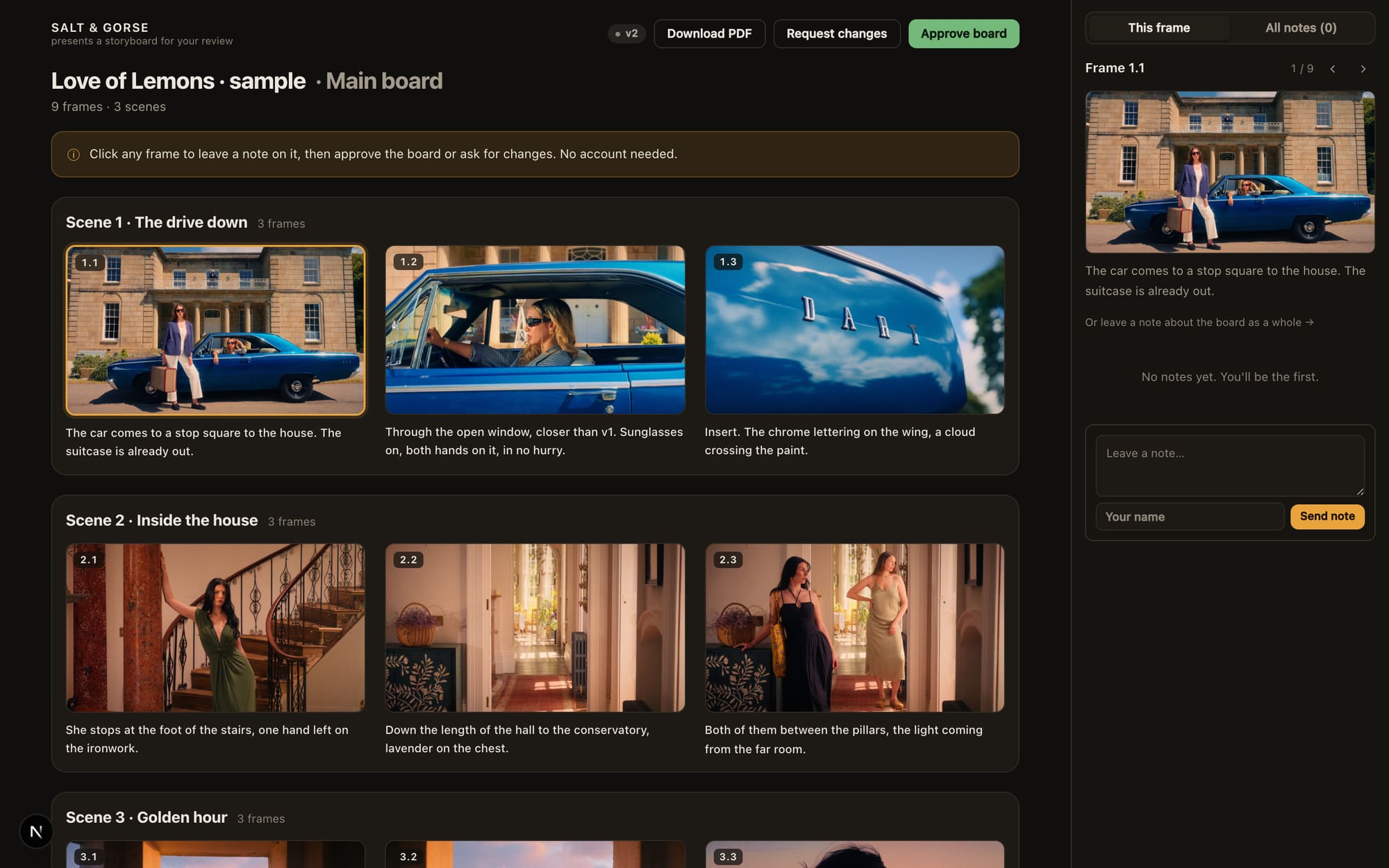
What the client sees: the board itself, numbered comments, approval on the record.
Take the intention onto set
This is the point where a lot of storyboard workflows break. Somebody takes the approved board and retypes the shots into a spreadsheet. The spreadsheet gets reordered for production. The board stays in scene order. By lunch, the two documents are describing slightly different films.
I would much rather the shooting plan derive from the board. The crew does not need every piece of client-facing presentation on set, but the actual frame and the actual shot should remain connected. When somebody asks "what are we getting here?", the fastest answer is normally the picture everyone has already agreed on.
That principle is one of the reasons we built Storybrdr. The board can move from creative order into shooting order without becoming a different set of shots, and the production record can stay attached to them as the day runs.
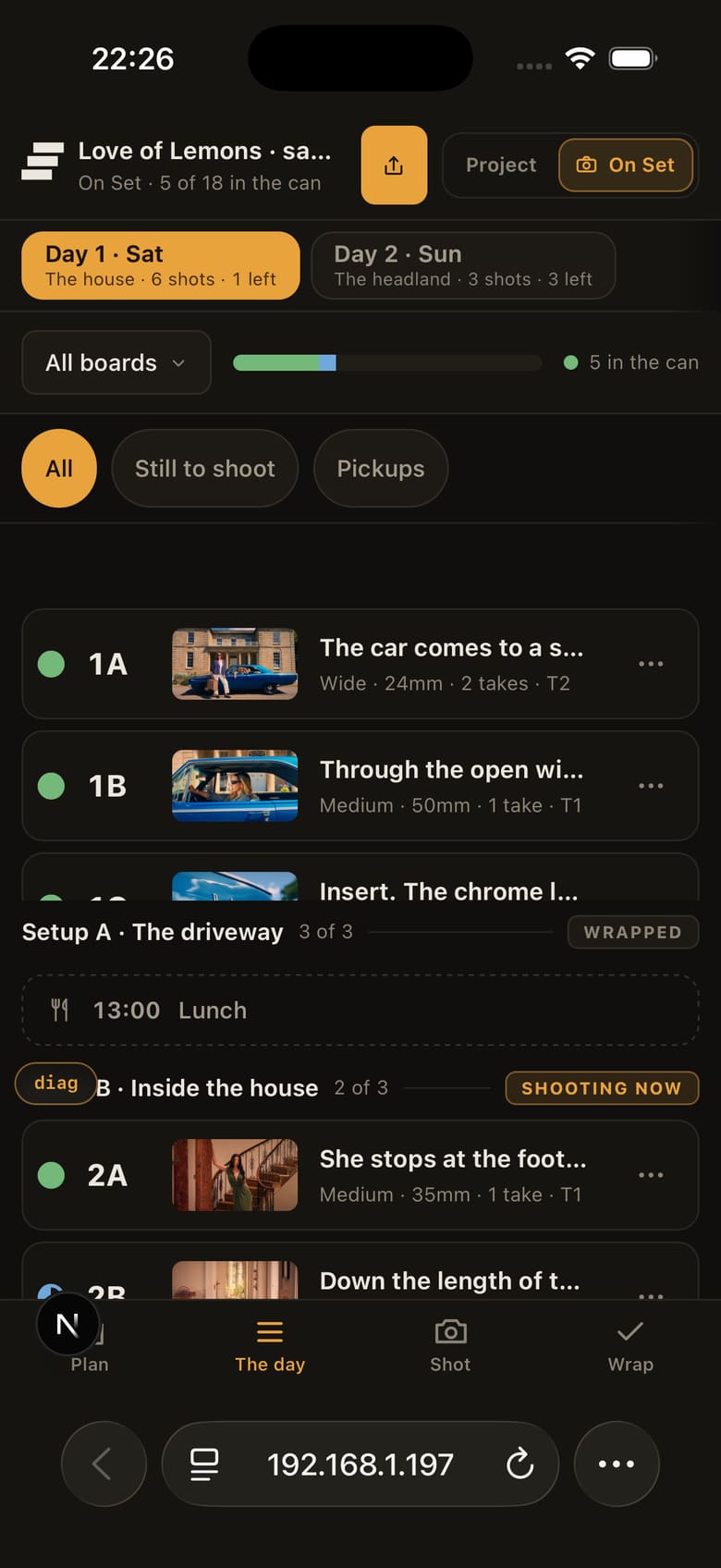
The same board, now in shooting order on the day.
If you are still choosing what to build it in, the best storyboard software in 2026 compares twelve tools by what has to happen after the frames exist. If you would rather work on paper first, the free storyboard templates print in five ratios.
The test
A good commercial storyboard is not the one that looks the most expensive, or has the most frames, or has already settled every lens. It is the one that leaves the director, the client and the crew imagining the same film before the expensive part starts.